Performance — 8 min
Four-season performance in a Northeast golf building
A four-season golf building in the Northeast needs engineered snow load, a continuously insulated and air-sealed envelope, a right-sized heat pump or in-floor heat, and humidity control. Done properly it holds temperature overnight and is comfortable within minutes of arriving.
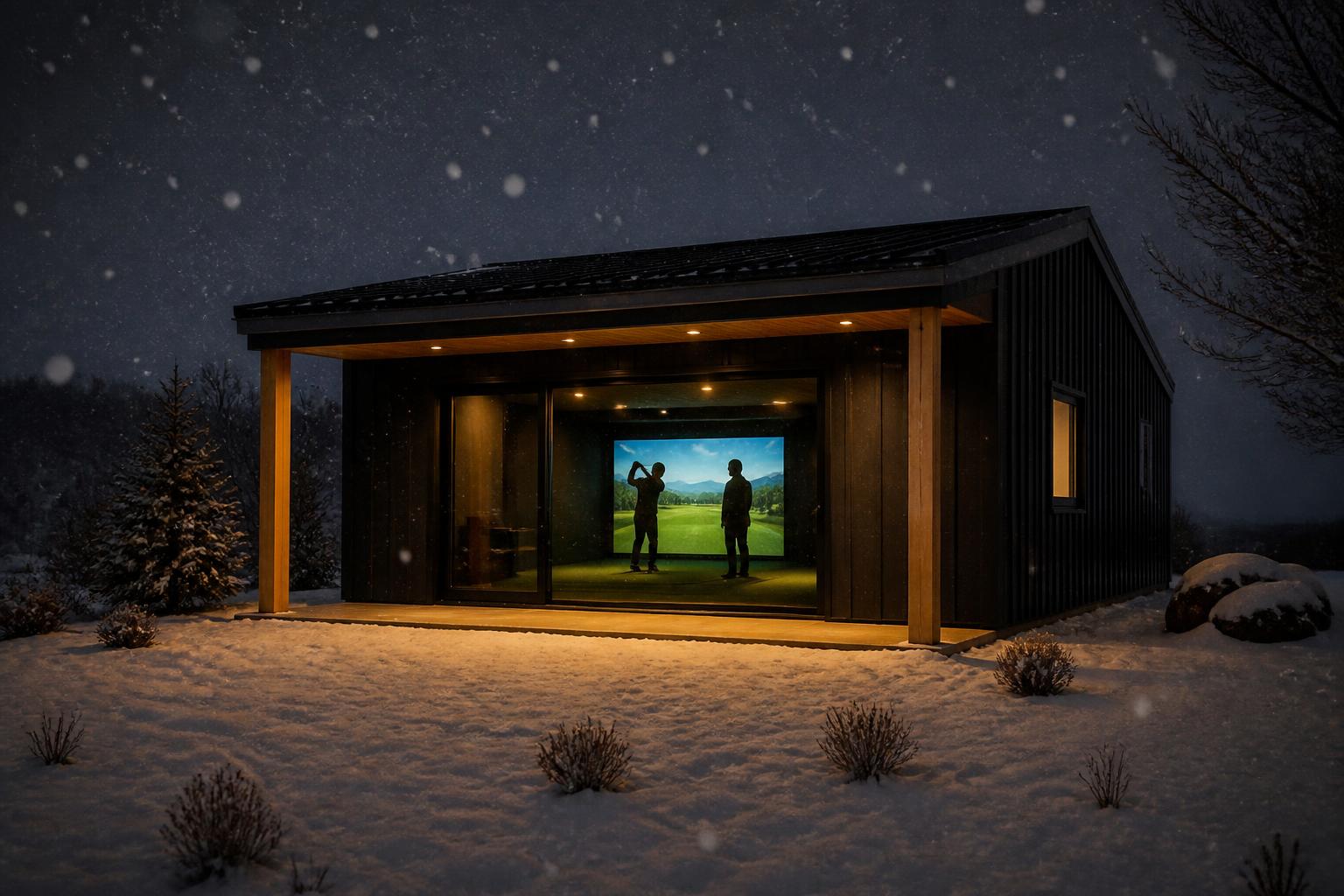
Snow load is a structural decision
Ground snow loads across northern New England commonly run 50 to 100 pounds per square foot, and higher in the mountains. That number drives rafter or truss sizing, connections, and the roof assembly.
It also drives where snow goes when it slides. A standing seam roof sheds beautifully and enthusiastically, which is wonderful until it's over the door you use. Roof orientation, snow retention and where the drip line lands are design decisions, not accidents.
The envelope
This is the part that separates a building from a shed with a heater in it, and it's mostly invisible once it's done.
- Continuous exterior insulation to break thermal bridging through the framing, on top of cavity insulation.
- Air sealing at every plane change — sill, top plate, penetrations, window and door openings. Air leakage, not R-value, is what makes a building feel cold.
- A properly detailed water-resistive barrier and a rainscreen gap behind the board-and-batten siding.
- Insulated, low-E glazing, sized for view and daylight without turning the building into a heat sink.
- An insulated, weatherstripped door you can open with cold hands and gloves on.
Heat and cooling
A ductless mini-split heat pump is the default: it heats efficiently down to serious cold, it cools and dehumidifies in July, it's quiet, and it needs no fuel line.
In a slab building, in-floor hydronic or electric heat underneath is a superb companion — it holds a stable baseline temperature and warms the surface you stand on, so the mini-split only has to handle the swing.
Sizing matters in both directions. An oversized unit short-cycles, never dehumidifies properly, and makes the building noisy and clammy.
Humidity, condensation and the equipment
Northeast summers are humid and golf buildings are full of electronics, turf and a large fabric screen. Unmanaged humidity means condensation on cold surfaces, musty turf, and unhappy hardware.
The mini-split handles most of it in cooling season. The envelope handles the rest by keeping interior surfaces warm enough that moisture never finds a cold plane to condense on.
In winter the opposite risk applies: a tight, heated building with poor detailing pushes moisture into the wall assembly. That's why the vapour and air control layers get drawn, not improvised.
How you actually run it
Most owners hold the building at a low setback temperature — somewhere in the 50s — and bring it up when they're heading out. In a well-insulated building with a slab, recovery is fast and the cost of holding that baseline is modest.
That's the whole promise. It's 12 degrees outside, you walk across the yard, and the building is ready before you've finished stretching.
Built for thirty winters
Standing seam metal roof, board-and-batten siding on a rainscreen, generous overhangs where the design allows, ice and water protection at the eaves, and flashing details done properly.
None of it is exciting. All of it is why the building looks the same in year fifteen as it did the week we handed it over.
All pricing is a working estimate, never a quote. Updated 2026-02-01.
Questions
The things people actually ask.
Read next
Construction
Foundations for a detached golf building
Slab, frost-protected shallow foundation, frost wall, helical piers and sonotubes — what each one is good at in Northeast frost.
Cost
What a detached golf simulator building actually costs
Working ranges for a purpose-built golf building in the Northeast, what drives the number, and where people are surprised.
Enough theory.Send us the yard.
We'll come back with a building size, a ceiling height, a working range and an honest read on your site.